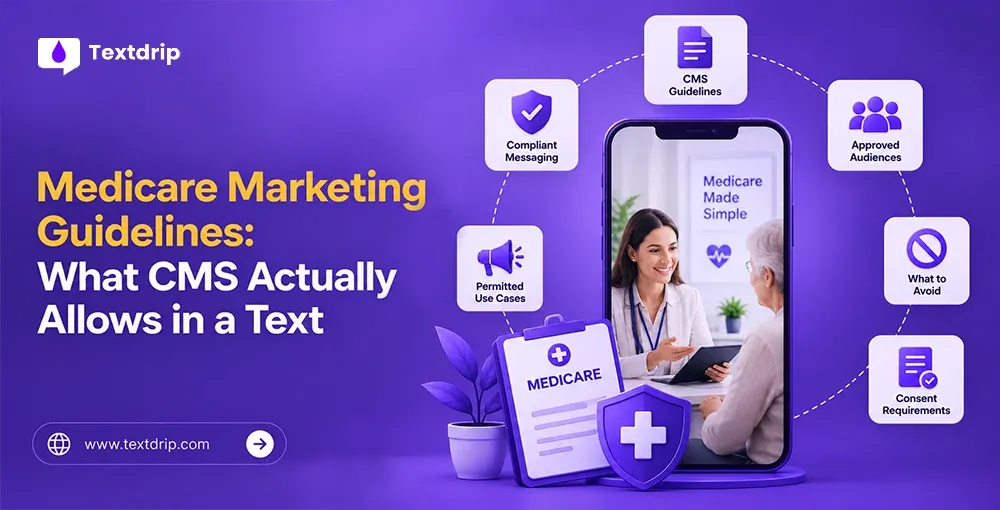
Texting a Medicare prospect feels simple, right? Type a message, click Send, and you’re done. But Medicare marketing is not like texting a discount code or a pizza coupon. CMS (Centers for Medicare and Medicaid Services) watches this space closely because the people on the other end receiving your text messages are often older, confused about their options, and easy targets for pushy sales tactics. If you send a single wrong text message, at the wrong time, to the wrong person without their permission, it can trigger a CMS compliance violation or a TCPA lawsuit. Both are expensive and easily avoidable by following Medicare marketing guidelines .
CMS rules tell you when you can text, who you can text, and what you are allowed to say in a text message. Once you know and understand these rules, texting becomes the fastest and most efficient way to reach Medicare beneficiaries.
This guide breaks down what CMS’s Medicare marketing guidelines allow in a text message. Let’s get started.
TL;DR
- CMS lets you text Medicare prospects, but only after you have permission to contact (PTC) them. You can't text anyone without their consent.
- Once someone gives consent or reaches out first, you can send plan information between 8 AM and 9 PM their local time. Some states cut those hours shorter.
- As of October 1, 2026, CMS's new CY2027 rule drops the old 48-hour Scope of Appointment wait. So agents can text and meet the same day.
- You still need carrier (10DLC) registration for your texts to be delivered.
- If you break these rules, you risk fines, plan sanctions, or losing your license to sell.
- Use a text message marketing platform like Textdrip to send CMS and TCPA compliant text messages.
What is CMS?
The full form of CMS is Centers for Medicare & Medicaid Services. It is a U.S. federal agency, part of the Department of Health and Human Services. CMS runs two government health programs.
- Medicare - Health coverage for people 65 and older and some younger people with disabilities.
- Medicaid - Health coverage for low-income individuals and families, and the Health Insurance Marketplace.
Simply put, CMS is the agency that writes and enforces the rules on how insurance agents and companies can promote Medicare plans, including what is allowed in a text message.
The Importance of Compliance in Medicare Marketing and Communications
Adhering to Medicare compliance is not only about avoiding penalties; it is also about creating a trustworthy, consumer-centric approach that is beneficial for everyone. When you communicate clearly and transparently, your clients understand their options better. This leads to a more satisfying customer experience, and your customers perceive you as a highly reliable and knowledgeable agent. When clients trust the information you provide to them, they feel confident and choose the right plan. So, compliance is a critical part of earning the trust of your customers.
By following Medicare marketing guidelines, you ensure that the plans you present are promoted accurately and that you are setting clear expectations with your clients.
Major Factors of CMS Medicare Marketing and Communication Guidelines
Here are some key factors and compliance guidelines that every Medicare agent should follow when communicating and marketing Medicare plans.
1. Marketing vs. Communication
Understanding the difference between marketing and communication under CMS is important. Marketing means anything meant to steer someone toward enrolling in a specific plan or staying with the one they already have. A text message comparing Plan A’s premium to Plan B’s premium is marketing.
Communications is any material or activity that gives existing or prospective members general information about Medicare without trying to influence enrollment decisions.
This distinction is important because marketing materials face tighter rules than plain communications. CMS has outlined this in the MCMG ( Medicare Communications and Marketing Guidelines ), published under the Medicare Managed Care Manual.
2. SOA - Scope of Appointment
Before discussing or sending any information about a specific plan, agents must obtain a signed SOA (Scope of Appointment) form from the client. This form confirms that the client gave consent to discuss the plans and specifies which types of plans they want to learn about.
3. Permitted and Prohibited Language
CMS has clear guidelines on what language Medicare agents can and can’t use. When agents remain mindful of the language they use, it helps clients feel informed and ensures that their Medicare choices are based on clear, transparent information.
Agents can use factual and neutral language such as costs, plan names, and coverage benefits.
They can’t use words like “limited time," “free,” or phrases that create urgency or imply “government-backed.”
Remember that your Medicare clients want facts, not a sales pitch. So, if you stay neutral, it helps build trust and give clients the clarity and confidence they need to make the right choice.
4. Educational vs. Sales Event
There is a clear difference between educational and sales events, and CMS distinguishes between the two as well. In educational events, you can’t discuss specific plans, while in sales events you should share only plan-specific information.
Educational events are helpful for building relationships with clients and are highly regulated to avoid steering. On the other hand, sales events allow agents to discuss specific plan details, answer questions, and help with enrollment.
Promote events clearly, informing clients whether the event is educational or a sales event. This helps keep clients informed and maintain compliance.
5. Usage of Approved Marketing Material
You can use only CMS-approved material while promoting Medicare plans. This includes printed, digital, and spoken content that advertises Medicare advantages or plans. Ensure all your material is approved by CMS or an FMO (Field Marketing Organization).
The Importance of Permission to Contact (PTC) Guidelines in SMS
Permission to Contact, or PTC, is a term used to refer to consent. It turns your outreach from unsolicited into solicited.
CMS does not have any official PTC form, but PTC exists whenever a beneficiary does one of the following:
- Signs a Business Reply Card or a lead form asking to be contacted.
- Calls or texts you first.
- Signs a Scope of Appointment at an event.
- Fills out a website opt-in form requesting more information.
How Long Does PTC Last?
PTC or SOA is commonly tied to a 12-month validity window. Once that window closes or once the beneficiary’s purpose has been met, you need fresh permission before texting again.
Let’s walk through the compliant PTC-to-text workflow with a simple example.
- A prospect fills out a BRC at a community health fair and checks a box that says "text me for more information."
- You log the date, the method of consent, and what they agreed to.
- Within the 12-month window, you send a text about the specific topic they asked about.
- If they don't respond or the topic changes, you get fresh consent before texting again.
In short, all you do is use the documented consent within a specific time window.
What CMS Allows You to Say in a Text Message
Once you have the PTC, you can send a text message to your clients, but here are a few things that CMS allows and doesn’t allow you to say in a text message.
CMS allows you:
- Reply to someone who contacted you first and discuss any plan types covered by their Scope of Appointment.
- Ask a beneficiary for permission to contact them again in the future, as long as you don't ask during an unsolicited message.
- Send side-by-side comparisons of plan benefits, premiums, and copays using CMS-approved materials once a valid SOA is on file.
CMS does not allow you to:
- Send a marketing text to anyone who hasn't given PTC.
- Use auto-dialed or mass-blast texts to numbers that never opted in.
- Make misleading claims about benefits, costs, or plan availability.
When Can You Send a Medicare Text?
According to TCPA rules, you can send a Medicare marketing text between 8 AM and 9 PM in the recipient’s local time zone, and you must respect quiet hours. This rule sits on top of CMS’s own PTC rules. You need both consent and correct timing. Some states even go further and shrink that window.
| State | Permitted Sending Window | Prohibited Quiet Hours |
| Alabama | 8 AM to 8 PM (Mon-Sat) | 8 PM to 8 AM, no Sundays and state/federal holidays |
| Connecticut | 9:00 AM – 8:00 PM | 8:00 PM – 9:00 AM |
| Florida | 8:00 AM – 8:00 PM | 8:00 PM – 8:00 AM |
| Illinois | 9:00 AM – 9:00 PM | 9:00 PM – 9:00 AM |
| Kentucky | 10:00 AM – 9:00 PM | 9:00 PM – 10:00 AM |
| Louisiana | 8:00 AM – 8:00 PM (Mon–Sat) | 8:00 PM – 8:00 AM, no Sundays and state holidays. |
| Maryland | 8:00 AM – 8:00 PM | 8:00 PM – 8:00 AM |
| Massachusetts | 8:00 AM – 8:00 PM | 8:00 PM – 8:00 AM |
| Michigan | 9:00 AM – 9:00 PM | 9:00 PM – 9:00 AM |
| Minnesota | 9:00 AM – 9:00 PM | 9:00 PM – 9:00 AM |
| Mississippi | 8:00 AM – 8:00 PM (Mon–Sat) | 8:00 PM – 8:00 AM, no Sundays |
| Nevada | 9:00 AM – 8:00 PM | 8:00 PM – 9:00 AM |
| New Mexico | 9:00 AM – 9:00 PM | 9:00 PM – 9:00 AM |
| Oklahoma | 8:00 AM – 8:00 PM | 8:00 PM – 8:00 AM |
| Pennsylvania | 9:00 AM – 9:00 PM (Mon–Sat)1:30 PM – 9:00 PM (Sun) | 9:00 PM – 9:00 AM (Mon-Sat)Before 1:30 PM (Sun) |
| Rhode Island | 9:00 AM – 6:00 PM (Mon–Fri)10:00 AM – 5:00 PM (Sat) | 6:00 PM – 9:00 AM (Mon-Fri)No Sunday sends are permitted. |
| South Dakota | 9:00 AM – 9:00 PM (Mon–Sat) | 9:00 PM – 9:00 AM; no Sunday sends are permitted. |
| Texas | 9:00 AM – 9:00 PM (Mon–Sat)12:00 PM – 9:00 PM (Sun) | 9:00 PM – 9:00 AM (Mon-Sat)Before 12:00 PM (Sun |
| Utah | 8:00 AM – 9:00 PM (Mon–Sat) | 9:00 PM – 8:00 AM. You can’t send text messages on Sundays. |
| Washington | 8:00 AM – 8:00 PM | 8:00 PM – 8:00 AM |
| Wyoming | 8:00 AM – 8:00 PM | 8:00 PM – 8:00 AM |
Source: Link
If you want to learn more about state-wise text messaging rules, check out our latest blog on text messaging laws by state .
How Do CMS, TCPA, and Carrier Rules Stack for SMS?
Sending a compliant Medicare text means sending a text message that complies with CMS, TCPA, and carrier rules.
CMS rules - You need PTC or an SOA before you text, and your material has to follow MCMG content rules.
TCPA rules - You need consent, and you need to send it within permitted hours.
Carrier rules - U.S. mobile carriers require A2P 10DLC registration before your texts will even be delivered. If you skip this step, your messages get filtered as spam.
Latest Update About CMS Rules: 2026 - 2027
CMS updates the MCMG regularly. The latest and upcoming updates about CMS rules are as follows.
| Date | Update |
| April 6, 2026 | CMS published the CY2027 Medicare Advantage and Part D final rule. |
| June 1, 2026 | The rule became effective. |
| October 1, 2026 | Removal of the 48-hour SOA wait and the 12-hour educational-to-marketing event gap. |
| Call and text record retention | Dropped from 10 years to 6 years, with the first 3 years required to be audio. |
| TPMO disclaimers | They need to come before any benefits discussion. |
Send Fully Compliant Text Messages With Textdrip
Compliance is the foundation of a successful Medicare practice. It does not just mean following rules, but it is a way to provide your clients a trustworthy and transparent experience that helps build loyalty and satisfaction. By following CMS guidelines, you can create a highly reliable, client-centric Medicare practice that clients will recommend to others and return to.
CMS keeps you from sending the wrong text to people who never gave you consent. You need to first obtain permission, send a text message during legal hours, and use approved material. If you do these consistently, texting becomes the fastest and most efficient way to reach beneficiaries, but it is quite challenging to get it right on every text, in every state, every day. Textdrip handles this for you. It logs consent, schedules text messages within the recipient’s legal quiet hours, and takes care of carrier registration behind the scenes.
Book a Textdrip demo now and see how compliant Medicare texting can run on autopilot.
FAQ's
What is permission to contact in Medicare?
Permission to contact (PTC) is a beneficiary's consent or their own outreach to you. It makes your follow-up solicited, and without it, CMS prohibits direct contact, including texting.
How often are the Medicare Communications and Marketing Guidelines updated?
CMS reviews and updates the MCMG regularly, often annually, but major changes can also arrive mid-year through a final rule.
What time of day can I send Medicare text messages?
According to TCPA rules, you can send Medicare text messages between 8 AM and 9 PM in the recipient's local time zone. Some states, like Florida and Rhode Island, set shorter windows, so check your recipient's state before scheduling.
Do I need my carrier's approval before sending a Medicare marketing text?
Yes, you need your carrier’s approval before sending a Medicare marketing text. Mobile carriers require A2P 10DLC registration before your texts will be delivered. Moreover, if your message references a specific plan, the insurance carrier or plan sponsor must approve that marketing material before you use it.