These days, it has become quite challenging for insurance agents to communicate employee benefits effectively due to the many options available. On the one hand, employees are increasingly seeking comprehensive benefits tailored to their needs and those of their family members. They avoid what they don’t understand, and insurance plans top this list. A year-round open enrollment communication strategy can help bridge this gap for both employers and insurance agents.
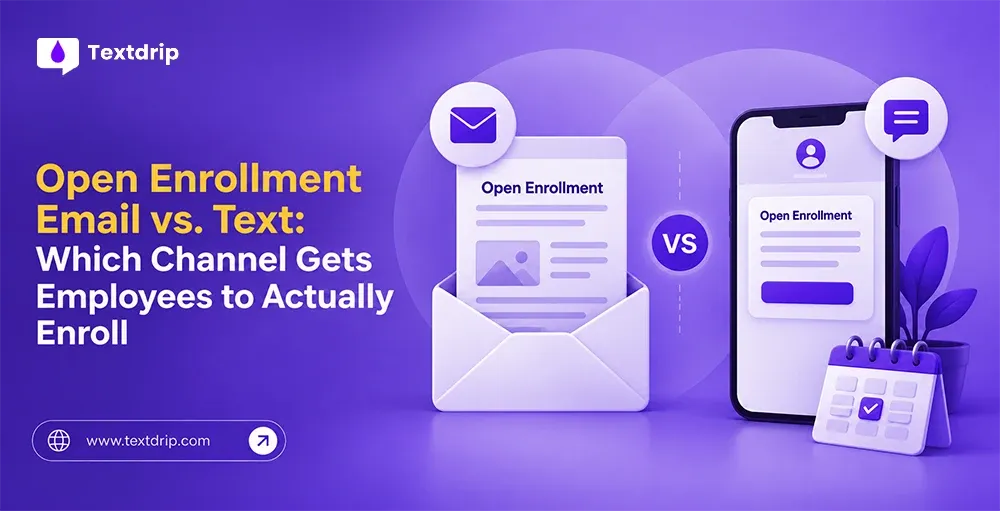
But to make open enrollment go smoothly, you must choose the right communication channel. When it comes to communicating benefits, both email and text work well, but text messages have higher open and response rates, so they allow people to act on time and with clarity and confidence.
This blog explains what open enrollment communication is, what email does well, what texts do well, and which communication channel drives more on-time enrollment.
TL;DR
- Text messaging delivers a 98% open rate, with messages typically read within three minutes, making it the most powerful channel for reaching employees.
- Emails are still best for detailed plan information, forms, and documents.
- SMS is best for reminders, deadlines, and getting clients (employees) to take action fast.
- You will experience the best results if you lead with text and back it up with email.
- An automated SMS marketing platform like Textdrip can help you personalize and schedule text messages, leverage two-way texting, send follow-ups, and measure click-through rates to improve next year’s campaign.
- Book a demo to see how you can smooth your open enrollment communication strategy.
What is Open Enrollment?
Open enrollment is the time period and opportunity for employees to select or modify their benefits for the upcoming year. This 2-4 week window typically occurs in the fall and allows employees to choose insurance plans, adjust coverage levels, or make changes to insurance plans.
Employer open enrollment could include any of the following types of insurance plans or benefits.
- Life insurance
- Health insurance
- Pet insurance
- Vehicle insurance
- Vision insurance
- Dental insurance, and more.
During open enrollment, employees can sign up for various health insurance plans, including Medicare and Medicaid plans, federal marketplace plans, and employer-provided plans.
Different states that offer insurance plans have their own open enrollment periods. If you are planning to purchase insurance through the federal marketplace, the open enrollment window is from November to mid-January. If the employees miss this window, they have to wait until next year. The only exception to this is certain qualifying life events like childbirth, marriage, or loss of other coverage.
What is Open Enrollment Communication?
Open enrollment communication refers to every text message an insurance agent sends to help a client choose and complete their coverage. This includes plan details, deadlines, and answers to client questions. For most insurance agents, this time period is short. That’s why getting the message seen matters as much as getting it right.
Here, the goal is not just to send information but to ensure clients see it, understand it, and act on it before the deadline.
Is It Required to Notify Employees?
Yes, employers are legally obligated to notify employees about open enrollment, including benefits, deadlines, and plan details. However, the specific requirements depend on your company size and the benefits you offer. Federal and state regulations vary. Therefore, understanding your specific obligations helps avoid penalties.
Why Does Open Enrollment Communication Often Fail?
Open enrollment is not a single text message; it is weeks of updates sent to many clients at once, each with different plans and deadlines.
Here are a few reasons why messages get missed:
- Clients (employees) often get flooded with emails from carriers, employers, and agents.
- Approximately 87% of people won’t answer a call from a number they don’t recognize, so phone calls often go unanswered.
- Enrollment windows are short, so a delay of a few days can mean a missed deadline.
You can’t fix this situation by sending more messages. All you need to do is send the right message on the right channel at the right time.
Email vs. Text Message: Which Communication Channel Should You Use?
The way you communicate about open enrollment determines whether employees actually engage with it or miss it. Let’s understand what these two communication channels do well and what their limitations are.
Emails for open enrollment: strengths and weaknesses
What emails are good at
Email is the best communication channel when you want to share anything in detail. Plan comparisons, coverage documents, and enrollment forms can be shared via email. Clients can save them, read them slowly, and come back to them later.
What emails struggle with
The real issue with email is not the content but whether people open it or not. The average open rate for email is between 20% and 30% . Even when clients open an email, it can take up to 90 minutes . On the flip side, text messages get read within three minutes of receipt. This means email is good for sharing detailed information, but many clients never see it in time.
SMS for open enrollment: strengths and weaknesses
What SMS is good at
Text messages usually get seen fast. Their open rate is around 98%, and most messages are read within three minutes of receipt. SMS drives more action than email. Its click-through rate is 10.63% , whereas the click-through rate for email is 2.6%. The response rate for SMS is approximately 45%. Renewal responses come three times faster over text than email.
Therefore, text messages are the right choice for deadline reminders, short and simple questions, quick scheduling links, and nudges to finish an unfinished enrollment.
What SMS struggles with
Text messages are not ideal for sharing long or detailed information. The SMS character limit is 160 characters, so a full plan comparison won’t fit in a text message. According to TCPA rules , agents need a client’s permission before texting them. Medicare and ACA agents need to follow the Scope of Appointment (SOA) and TPMO disclosure rules.
Open Enrollment Communication: Email vs. Text
| Metric | Email (Approximate) | Text |
| Open rate | 27% | 98% |
| Time to open | 90 minutes | 90 seconds to 3 minutes |
| Click-through rate | 2.6% | 10.63% |
| Response rate | Low | |
| Idea for | Plan details, forms, documents | Reminders, deadlines, and quick replies. |
| Rules to follow | Standard opt-out | TCPA consent + SOA/TPMO for Medicare/ACA |
Text messages win on speed and open rates while emails win on detail. Most agents need both.
Benefits Communication Strategy: Why Insurance Agents Need Both Channels
A good communication strategy is not choosing any one channel. It uses text messages to get seen and email to carry the details. This order works because a client who never opens the email never sees the details, no matter how well written it is. On the other hand, an SMS without any background information can leave the client confused about what to do next.
When these two channels are used together, the typical flow looks like this: SMS alerts the client that enrollment is open and points them to more information. Email follows up with the full plan details and next steps. SMS comes back later to confirm the deadline and push action.
In short, the ideal strategy is not about sending more messages but about sending the right messages through the right channel at the right point in the enrollment window.
Open Enrollment Communication Ideas for Insurance Agents
An open enrollment communication campaign has four critical stages.
Stage 1: Two Weeks Before Enrollment Opens
Start building excitement two weeks before enrollment opens. This gives employees time to review their insurance plan options. You can lead the communication via an open enrollment text message campaign. Make sure you personalize your text message to enjoy higher engagement rates.
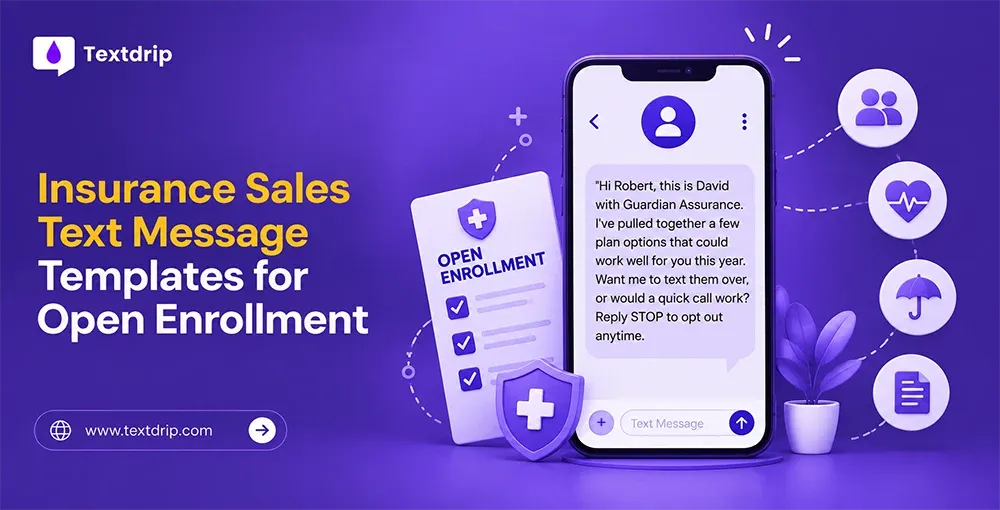
[Your insurance company name/agent name]: Hey, [client name]! Open enrollment starts [Date]. We will share plan option details via email. Reply STOP to opt out.
Email: Include all the details about open enrollment in the email.
Stage 2: Enrollment Opens
When enrollment officially begins, make sure your text message stands out. To do that, you can include step-by-step instructions and make it easy to act right away.
[Agent Name]: Hi [Client Name]! Open enrollment has already started. Review your options at [Link] or reply to book a call. Reply STOP to opt out.
Email: Include full plan details, comparison information, and clear instructions about the next step.
Stage 3: Midway Point
At this stage, you should focus on clients who have not responded yet or completed their selections. Inform them via SMS about the consequences of missing enrollment. Generally, a short nudge works better than another long email. You can use an automated SMS marketing platform like Textdrip for two-way texting or to send automated reminders.
Hey [Client Name]! Open enrollment ends [Date]. [X] days left. You can complete your benefits at [Link]. If you need any help, reply YES. I’ll call you. Reply STOP to unsubscribe.
Stage 4: Final Deadline
In this final stage, you need to make your communication short, clear, and shift to urgency mode. Make it clear that after the deadline, changes are not possible except in cases of qualifying life events. After the deadline, employees have to wait until next year to make changes.
When you want a quick response, SMS is the best communication channel.
[Agent Name]: LAST CHANCE—enrollment closes today at [Time]. Reply now or call [Phone] before it's too late. Reply STOP to opt out.
Here are some more open enrollment communication ideas that are worth trying.
- You should segment by client type. Medicare clients, ACA clients, and group plan members often respond to different messages. So, send personalized text messages instead of a blast text message.
- Use two-way texting for questions. A client who can text back "What's my deductible?" and get a fast answer is more likely to finish enrolling than one who has to call and wait.
- Track who's opened but hasn't acted. Following up with clients who saw the message but didn't click through catches people before the deadline, not after.
- Ask for feedback once enrollment closes. A quick post-enrollment text survey shows what worked and what to fix next season.
Employee Benefits Communication Best Practices for Insurance Agents
Educating and informing employees about their benefits is an integral part of the open enrollment communication. Here are some tips that insurance agents should keep in mind.
- Obtain explicit consent before sending text messages, because TCPA requires it. Medicare and ACA agents also need SOA and TPMO disclosure.
- Start informing and educating employees about benefits early, so they have ample time to understand their benefits and options, discuss with their families, and determine their needs for the following year.
- Keep the SMS character limit in mind and send short and clear text messages. Include only one point per message: a simple question, a link, or a deadline.
- Strengthen your communication strategy by using text and email. Use email for sending detailed information about anything that a client needs to read closely or save for later.
- Whenever it is possible, personalize the message . When a client receives a message with their name and a relevant, suitable situation, you get more replies compared to a generic blast.
- Check what is working and what is not by measuring metrics like open rate, click-through rate, engagement rate, and more. Don’t just look at whether a message was sent.
- Get feedback, as it will help you improve your strategy for the next year’s campaign.
- Use an automated texting platform like Textdrip, as manually texting every client during AEP is time-consuming and unrealistic. SMS automation helps you save time during enrollment season.
Want to learn how SMS can solve open enrollment mistakes ? Here is our detailed guide on it.
Final Thoughts
During open enrollment season, email and text messages do different jobs. Email holds the details about plans, events, and more, while text messages get the clients to see your message and act on it. With a 98% open rate and a 45% response rate, text messages help close the gap between “message sent” and “client enrolled.”
Sending reminders manually one by one is hard to manage during AEP (Annual Enrollment Period). Textdrip helps you deal with it. It helps you automate enrollment reminders, run two-way text conversations with clients, and stay TCPA compliant without losing the personal touch that gets people to reply. All you have to do is lead with text and back it up with email. Mixing both communication channels helps you make the most of open enrollment this year. So, implement the above-discussed open enrollment communication ideas and stand out from your competition. Book a Textdrip demo to drive more business this open enrollment season.