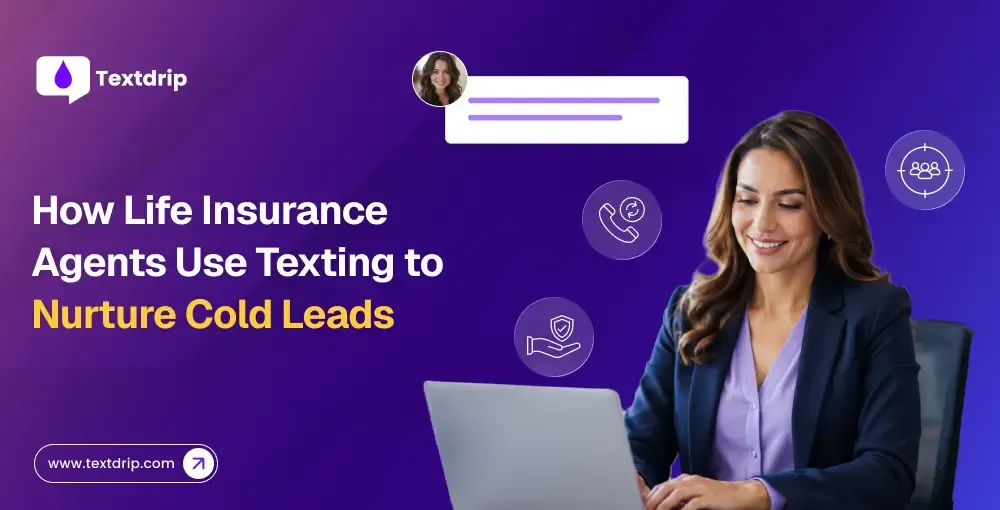
Cold leads are dead leads. They are simply prospects who haven’t yet been approached in the right way. Every insurance agent has this type of lead list. People who filled out a form six months ago, requested a quote, and then went silent; or those who said “they'd follow up later” and never did. Most insurance agents give up on these leads far too quickly. They make one call, leave a voicemail, and move on. But that is where they make the biggest mistake. The truth is, the lead didn’t lose interest; the insurance agent lost the moment.
In this situation, SMS for insurance agents can be the game-changer. A short, clear, friendly SMS can do what ten phone calls and five emails often can’t. It can gently nudge your cold leads to read your text, reply, and restart the conversation without sounding pushy or overly sales-focused.
In this blog, we’ll explore how smart insurance agents use texting to turn cold leads into booked appointment calls and closed policies.
But before diving deep into the strategies, let’s first understand why leads go cold in the first place.
TL;DR
- Cold leads are simply leads who never received a follow-up that felt easy to respond to.
- SMS has a 98% open rate and a 45% response rate, compared to email, which averages just a 20% open rate and a 6% response rate.
- Insurance agents can effectively nurture cold leads through drip SMS campaigns, value-first texts, life-event triggers in text messages, and easy yes/no questions.
- An automated text marketing platform like Textdrip helps insurance agents automate messaging sequences, track consent, and follow up consistently, without missing a single lead.
Why Do Leads Go Cold?
Speed plays a crucial role in the insurance industry. According to a study , a 5-minute response window works best because it easily captures a prospect’s attention before they start browsing other options or request quotes elsewhere. Reaching a prospect within 5 minutes can boost conversion rates nine times compared to waiting half an hour. If you wait for an hour, the chances of lead conversion drop by 60%.
Most insurance leads who abandon a quote do it within 24 to 48 hours, giving agents a very short window to connect. The insurance industry sees quote abandonment rates of approximately 84%, which is higher than almost any other sector. This clearly means that most people who request a quote never buy from the first agent they talked to. They move on, get distracted, or simply forget. It is not that they don’t need coverage, but the real reason is that no one followed up in a way that felt easy to respond to.
Phone calls, voicemails, and emails alone can’t solve this problem. Texting, however, fits well into the follow-up process. It reaches prospects directly on their mobile phones, where they're most likely to see and respond.
Why Does Texting Beat Calls and Emails for Cold Leads?
Texting insurance leads works because people actually read texts. SMS boasts a 98% open rate, compared to email’s roughly 20%. Most text messages are read within three minutes of receipt.
Replies also play a crucial role in nurturing cold leads. Text messages have a 45% response rate, while email lags at just 6% . That’s the reason SMS is so effective for cold leads. It is not only about being seen, but also about getting a reply that can restart the conversation.
That’s exactly why SMS for insurance agents has become a core part of their sales process.
How Agents Use Texting to Nurture Cold Leads
Insurance agents can use texting to nurture cold leads by keeping the following tips and tricks in mind.
1. Re-Engagement Text
Cold leads don’t need a sales pitch. A good re-engagement text feels more like a check-in instead of a push. Re-engagement text respects the lead’s time and opens the door to conversations without demanding an immediate answer.
For example:
Hey Tia, it's Jenny from [Agency]! You looked into life insurance a while back, and I don’t want to leave you hanging. Still thinking about getting your family covered, or has the timing changed? Reply STOP to opt out.
2. Follow-Up Drip SMS Campaign
No one buys insurance from just one text. That’s why insurance agents build a drip SMS sequence to break the follow-up into small, spaced-out touches. Most sales, including insurance sales, require at least five or more follow-up touches before they close. This spaced-out approach matches how people actually decide.
Day - 1 - A Friendly Reconnect
Hey [Name], it's [Agent] from [Agency]. You reached out about life insurance a while back. I didn't want to just forget about you. Are you still thinking about it, or did things change? Reply UNSUBSCRIBE to stop getting messaging from us.
Day - 4 - A Value Text
Hi [Name], quick fact for you: life insurance usually costs more as you get older. So waiting doesn't save you money. Do you want me to check your rate? It takes 2 minutes. Reply STOP to opt-out.
Day - 7 - The Objection Handler
It’s completely fine if now's not the right time, [Name]. Just so you know, most people your age get coverage for less than $20 a month. Do you want a quick look before you decide? Reply STOP to unsubscribe.
Day - 10 - The Social Proof
Hi [Name], a few clients this month found they were paying too much for too little coverage. Want me to run a free comparison for you? Reply STOP to opt out.
Day - 15 - The Easy Close
Hey [Name], I'll stop checking in after this one. Want me to send a free quote, or should I close your file for now? Either way is fine; just let me know. Reply STOP to opt out.
Each SMS serves a distinct purpose: one reconnects, one educates, one handles hesitation, one builds trust, and one offers a clean, guilt-free way out.
3. Value-First Text Messages
Cold leads went quiet for a reason. Maybe the timing was off, they got distracted, or they felt nervous about cost. Smart insurance agents don’t lead with “Are you ready to buy?” Instead, they open with something useful first. This kind of text message educates first and sells afterward. It gives leads a reason to respond without any pressure.
For example:
Quick fact: a healthy 30-year-old can often get $500,000 in coverage for less than the price of a coffee a day. Want us to check your rate? Reply STOP to opt out. - [Agency Name].
4. Use Life Events as Natural Re-Entry Points
Life insurance easily connects to real-life moments such as a new baby, a new job, a mortgage, or even a birthday. Insurance agents track these triggers and send text messages at just the right time. This approach can easily turn a cold lead warm again because the timing feels personal and relevant.
For example:
Hey [Name], heard about the little one arriving soon; congrats! A lot of new parents update their coverage right around now. Want us to check what that'd look like for your family? Reply STOP to opt out. - [Agency Name].
5. Keep SMS Character Limit in Mind and Skip the Jargon
Life insurance is confusing enough, so if an agent uses terms like “underwriting,” “riders,” or “cash value accumulation” in early texts, it only overwhelms people. Instead, they can share these details on a call. Also, they should keep text messages short and clear, and the SMS character limit in mind. Life insurance agents should send a text message that asks one simple question. Their messages should never feel like a letter.
6. Make Replying Effortless
The best insurance text message gives leads an easy way to say yes or no. Instead of sending vague text messages like “let me know if you’re interested,” agents ask a specific question. “Would 11 AM or 3 PM work better for a quick 5-min call?” This small change can turn a vague message into one that is easy to answer with just a single word.
7. Stay Compliant and Consistent
Insurance agents must obtain explicit written consent before sending marketing texts to leads. They must also include an opt-out option in every message. This protects the lead’s trust and keeps the agent’s number from getting flagged as spam.
Most insurance agencies use a dedicated text marketing platform to manage consent, timing, and message history in one place, rather than relying on personal phones.
A personal phone has no record of when a message was sent or whether a lead has already replied with “stop.” A text messaging platform like Textdrip automatically tracks all these, so agents can send text messages with confidence instead of guessing.
It solves insurance agents’ major problem of staying consistent. Without proper records, an agent might follow up with some leads and forget others. A platform built for texting keeps every cold lead on a schedule, so no one gets overlooked, even during busy weeks.
8. Track What’s Working and Adjust Accordingly
The insurance agents who get the best results don’t just send texts and hope for the best. They track which messages get replies and which ones go ignored. For example, re-engagement texts get several replies a week, but a generic “checking in” text message gets almost none. They use this information and double down on messages that work and drop what doesn’t.
After a few months of testing, insurance agents build a set of proven templates instead of guessing every single time. This saves time and steadily improves results over the long run.
Why These Approaches Convert Cold Leads
Cold leads are not leads who said no, but they’re people who never had any reason to say yes. SMS for insurance agents solves three problems at once: text messages get seen, get a reply, and a short, friendly text message feels human.
Insurance agents who build a simple drip SMS sequence for cold leads consistently turn them into booked appointments. The truth is, the lead was never really gone; they needed the right nudge, at the right time, in the right format.
Final Thoughts
Cold leads that are sitting in your spreadsheets are a wasted opportunity. Leads might not answer your calls or ignore your emails, but when you send a short, well-timed text message, there is a high chance that they will open it, read it, and reply.
SMS marketing for insurance agents is not about sending the same message to every lead. It is all about sending small, thoughtful texts that respect the lead’s time and bring them back into the conversation naturally.
The real challenge is not writing the text, but it is staying organized. Who to text, what to text, and when to text without losing track of a hundred conversations at once. That’s where an automated SMS marketing platform like Textdrip comes in. It lets insurance agents build re-engagement drip sequences, schedule messages, and track consents and opt-outs automatically. It lets insurance agents see every cold lead’s message history in one place so they never miss follow-ups.
Book a Textdrip demo today and start with one simple re-engagement text. Send it to ten cold leads and see how many replies you get. It is the easiest proof that texting works, and when you use the right platform like Textdrip, it becomes even easier and faster to breathe new life into your sales pipeline.
FAQs
How do life insurance agents get cold leads to respond by text?
Life insurance agents can get cold leads to respond by sending short, personalized, and friendly text messages that deliver quick value and encourage replies.
Can I automate follow-up texts to insurance leads?
Yes, you can automate follow-up texts to insurance leads by using an automated SMS marketing platform like Textdrip. Its schedule SMS and drip SMS features let you schedule text messages in advance and send them at the right time.
How do I keep insurance client information secure when texting?
You can keep insurance client information secure when texting by avoiding sending sensitive details like Social Security numbers or health data via standard SMS. Instead, you can use a compliant, encrypted text messaging platform like Textdrip, obtain explicit client consent, and direct clients to a secure client portal for viewing confidential policy documents.
How many times should I follow up with a cold insurance lead?
You should follow up with a cold insurance lead 4 to 5 times before moving them to a long-term nurture campaign.