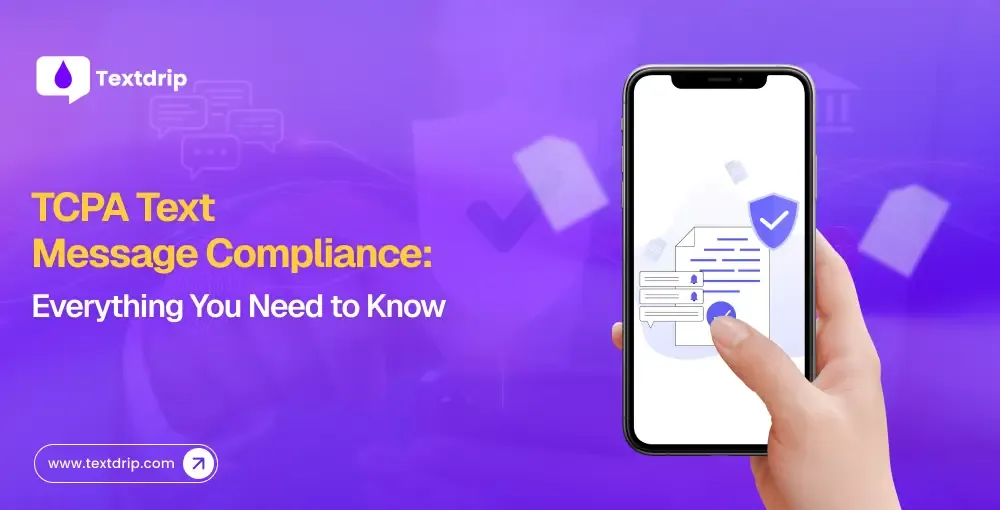
With a 98% open rate and a 45% response rate, SMS is one of the quickest and most effective ways for businesses to reach both their existing and potential customers. However, it also opens the door to privacy violations.
Texting laws are designed to protect customers from fraud, spam, and unwanted messages from businesses and unauthorized senders. These text message rules safeguard consumer data and privacy.
Complying with text messaging laws by state saves your business a lot of money and preserves your business reputation.
In this article, we will discuss federal and state-specific texting laws. You will learn about their requirements, the penalties for non-compliance, and a few best practices to maximize the ROI of your SMS marketing campaigns .
TL;DR
- Businesses can’t send unsolicited text messages to consumers, as it is illegal and can result in significant fines.
- They need to get express written consent before sending any commercial text messages.
- Businesses must manage opt-ins and opt-outs and secure a detailed consent record.
- Complying with federal and state-specific texting laws helps prevent penalties, which is why businesses must comply with text messaging rules.
Federal Texting Laws Businesses Need to Know
Two federal laws regulate text messaging in the US, and it applies to all US states. TCPA ( Telephone Consumer Protection Act ) and the CAN-SPAM Act
Telephone Consumer Protection Act
TCPA is a regulation enforced by the FCC (Federal Communications Commission). It governs pre-recorded calls, telemarketing calls, and text messages to protect consumers from unsolicited marketing practices. In short, it restricts intrusive telemarketing methods like auto-dialers and pre-recorded messages. Under the TCPA, businesses must obtain prior express written consent before engaging in such marketing activities. If they don’t comply with these text messaging laws, monetary fines can cost up to $500 per violation, and they can reach up to $1,500 for willful violations.
When a consumer opts in to receive text messages, businesses need to disclose all the expectations of their SMS communications and provide a clear and simple way to opt out. They need to inform subscribers about:
- Type of messages they will receive
- The number of messages per week or month they can expect to receive
- Link to the privacy policy
- Clear instructions regarding how to opt out of receiving messages
- Link to the full terms and conditions of the SMS program
Want to learn how to stay legally safe in SMS marketing? Check our ultimate guide to SMS compliance.
CAN-SPAM Act
The CAN-SPAM Act gives recipients the right to opt out of business text messaging. This law is enforced and regulated by the FCC and protects consumers from unsolicited business text messages. Here are a few CAN-SPAM Act rules that apply to SMS marketing.
- Businesses can’t use false or misleading information in the SMS.
- Include clear opt-out instructions.
- Identify the message as an advertisement.
- Respect opt-out requests promptly.
- Respect timing and send text messages only during business hours based on the recipient’s time zone.
- You must ensure compliance with texting rules, even when another party is acting on your behalf.
Tips for Federal Texting Law Compliance
Here are a few tips to help your business stay compliant, avoid fines, and simplify processes without complexities.
- Businesses must maintain a detailed record of consent acquisition, such as date, method, and recipient details.
- Use a secure database to protect records from unauthorized access or manipulation.
- Always send a confirmation message immediately after opt-in to verify the recipient’s intent.
- Allow recipients to opt out anytime via multiple channels.
- Maintain an opt-out and Do Not Contact list to simplify contact management and keep your subscriber list up-to-date.
Businesses should regularly audit their SMS practices to identify and rectify potential compliance gaps.
In addition, mobile carriers like AT&T and Verizon require businesses to follow the following text messaging rules when texting customers.
- Avoid sending content related to SHAFT topics (Sex, Hate, Alcohol, Firearms, and Tobacco). Sending messages that include this type of content is strictly prohibited by CTIA.
- Businesses must have a 10DLC number to send messages and must follow the proper 10DLC registration and vetting requirements.
Text Messaging Laws by State
In addition to Federal texting laws, some states have enacted their own specific texting laws. Businesses must consider these state-specific regulations to ensure consumers in each state are protected from unsolicited texts and to help your business avoid hefty fines.
1. Arizona
House Bill 2312 , signed by the Arizona Governor, mirrors the TCPA, which mandates prior consent for automated communications. So, it prevents businesses from sending unsolicited text messages. In 2023, Governor Hobbs signed House Bill 2498 , which prohibits businesses from sending unsolicited text messages to individuals on the National Do Not Call Registry. Violating it leads to $1,000 fines.
2. California
The CCPA (California Consumer Privacy Act) gives consumers the right to know how their personal information is collected, used, and shared. To comply with the CCPA, businesses must disclose how they use and share personal data, provide clear opt-out methods to consumers, and stop texting consumers who opt out within 15 days of receiving their opt-out request.
3. Connecticut
The Public Act No. 14-53 , a law passed by Connecticut, requires businesses to obtain express written consent from consumers before sending commercial text messages. If businesses fail to comply with this texting law, they can be subject to a $20,000 fine. Additionally, businesses can’t call individuals registered on Connecticut’s DNC registry.
4. Florida
When it comes to text messaging laws by state, Florida has passed House Bill 761 under the Florida Telephone Solicitation Act (FTSA). The bill requires that businesses obtain express written consent before sending text messages to consumers. Consumers must be able to reply “STOP” to opt out. Businesses must respect opt-out requests from consumers and stop sending text messages within 15 business days.
5. Indiana
The House Enrolled Act 1273 was approved by the Indiana Governor in 2011. According to this law, businesses are prohibited from sending unsolicited text messages to consumers who have registered their numbers on the Indiana Do Not Call Registry.
6. New Jersey
Under New Jersey’s text messaging privacy law, Assembly 617 , businesses can’t send unsolicited text messages to New Jersey residents. They need to get express written consent before sending business text messages. Businesses must convey the number of text messages they will send or provide a way for consumers to opt out of text messaging communications. Violating this texting law can lead to penalties of $500 for the first offense and $1,000 for each subsequent offense.
7. Oklahoma
The OTSA – Oklahoma Telephone Solicitation Act of 2022 limits businesses to no more than three messages on the same subject within a 24-hour period. It also restricts texting before 8 AM and after 8 PM in the consumer’s local time zone. Additionally, the Act prohibits businesses from texting consumers who have not given explicit consent.
8. Virginia
In 2020, Virginia amended the Virginia Telephone Privacy Protection Act to protect consumers with non-Virginia area codes who reside in Virginia. Under this law, businesses sending commercial text messages must identify themselves and cannot send text messages to consumers on the Do Not Call Registry.
9. Washington
Washington’s Consumer Electronic Mail Act prohibits businesses from sending commercial text messages without prior consent from Washington recipients.
10. Wisconsin
ATCP 127, the law of Wisconsin, prohibits businesses from sending unsolicited text messages to consumers on the Do Not Call Registry. A Wisconsin resident can register his/her number for free on the DNC registry, and once the registration is done, it is permanent.
Practice Compliant SMS Marketing With Textdrip
Text messaging rules exist to protect consumers from unsolicited messages and to secure their privacy. These texting laws require businesses to maintain transparency about when, where, and how they will use consumer data. When businesses fail to comply with these SMS marketing laws, it can lead to hefty fines and legal penalties. However, if businesses follow these rules and plan their SMS marketing strategy intentionally, they will achieve higher response rates and better overall performance.
If you’re ready to create an SMS marketing strategy that boosts engagement, increases sales, and complies with texting laws, Textdrip can help you. With a user-friendly interface and easy-to-integrate texting solutions, Textdrip provides the tools and features you need to reach your customers safely and effectively. With Textdrip, you can refine your SMS marketing strategy and easily navigate the ins and outs of text messaging rules.
So, sign up for a FREE trial today and start sending compliant text messages.