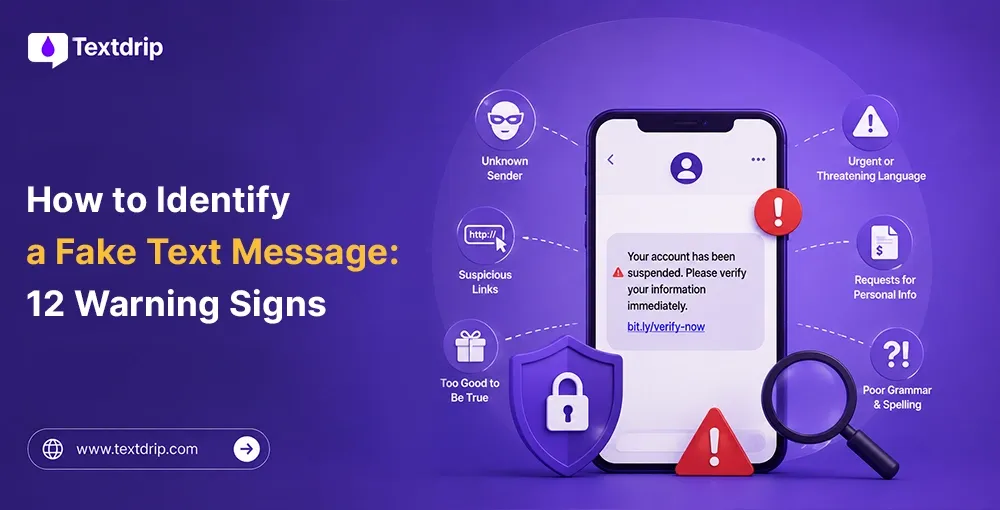
We live in a world of digital communication, where text messages have become a crucial part of our daily lives. And scammers know it’s hard to ignore a text message, so they easily fool people through text message scams. These scams are also called smishing or SMS phishing. A fake text message can do far more harm than most people realize. Scammers make it look legitimate and often trick people into giving their personal information, downloading malware, or clicking on malicious links. They make it seem urgent, official, and harmless, but one wrong click can compromise your money, identity, and personal information.
In this blog, we will show you how to spot a fake text message and what you can do to protect yourself from text message scams before they cause real damage. You can use these signs of a fake text message as a guide for what not to do while crafting and running your SMS marketing campaigns .
TL;DR
- According to the FTC (Federal Trade Commission) data, Americans reported losing $470 million in 2024, which started with a text message.
- Text message scams are becoming harder to identify even with AI.
- Knowing how to identify a fake text message can help protect your business.
- Some common signs include urgent demands, irrelevant messages from unknown numbers, requests for personal and financial information, suspicious links, and more.
- Fake package deliveries, fake job offers, and bank fraud alerts are some of the most common types of fake text messages.
- To avoid text scams, always be aware of unsolicited text messages, use phone number validation tools to verify numbers, never click on suspicious links, and be cautious about contact methods.
- Report text scams to the FTC and enable phone spam filters.
What are Fake Text Message Scams?
A fake text message is a fraudulent SMS designed to appear as though it came from a legitimate, trusted source. Scammers copy the tone, format, and language of real alerts that come from banks, financial institutions, delivery companies, payment apps, telecom providers, or shopping platforms.
Their only goal is to make people act quickly without thinking. A fake text message may ask you to do the following things.
- Share an OTP
- Share your personal and financial details.
- Update your bank account.
- Download an app
- Claim a reward
- Pay a delivery fee
- Click on a link to avoid account suspension.
- Call a fake customer support number.
Timing makes fake text messages dangerous. They reach you directly on your phone, feel personal, and usually make you panic. Many users trust SMS more than email, which makes text message scams easier to execute.
What Information Spammers Try to Collect Through Text Message Scams
Here are some of the most common types of information that most spammers attempt to collect via text message scams.
- Financial information such as debit card and credit card numbers, bank account details, passwords, and other related data.
- Personal information such as full name, home address, Social Security number, and phone number.
- Login credentials for online accounts such as social media accounts or email.
- Geolocation data, which they can use to track your movements.
- Other sensitive data that scammers can use for identity theft or other fraudulent schemes.
Why Scammers Use Text Messages to Scam People
Scammers frequently use text messages to scam people because SMS is affordable, highly effective, and easily automated. People tend to trust text messages and open them almost immediately. In short, people treat text messages with urgency, and when this urgency is combined with automation at scale, it makes text scams a quick and easy medium to reach many people. Scammers can send thousands of messages simultaneously via phone, computer, and VoIP (Voice Over Internet Protocol).
How to Identify a Fake Text Message: 12 Tell-Tale Signs
If you’re wondering how to identify a fake text message, here are some of the most common indicators to watch for. If even one of these applies to an unexpected message you’ve received, consider it a warning sign that the text message you’ve received is a fake text message. Keep in mind all these signs, as they are the answer to your “how to spot a scam text.”
1. The message is irrelevant.
If the message is completely irrelevant to you, there is no genuine reason you should have received it. It’s possible that the message was intended for another person. In the worst-case scenario, it’s spam. Whatever the case may be, it is best to delete messages from unknown senders without engaging them.
2. It creates urgency or threatens consequences.
Pressure is one of the most common and consistent features of a fake text message. Scammers typically need you to act quickly, before you have time to think. This means the message you receive will often create a time-sensitive or urgent situation. Look out for common phrases like “your account will be suspended in 24 hours,” and “you must respond immediately to avoid a fine.”
Keep in mind that government agencies, banks, or legitimate institutions never communicate with you through this kind of threatening text message and push you to take immediate action.
3. The text message contains poor grammar or spelling mistakes.
If a text message claims to be from a legitimate business or organization and is riddled with grammatical errors and spelling mistakes, that’s a major red flag. It may or may not be a fake text message. So, look for whether you receive a text message from someone you know or one that contains any questionable link. If you receive a text from someone you know, it may not be a fake text, but if it contains a questionable link, it may be a fake text. So, be mindful about it.

Image Source: Link
4. The sender’s number looks wrong.
Legitimate companies typically use five- or six-digit shortcodes for their SMS communication; you’ve likely seen this when you receive a text message from a bank for a one-time verification code. If a text message arrives from a long, unfamiliar phone number or unusual country codes, that’s a strong sign of a fake text message.
Keep in mind that scammers can also spoof phone numbers, making a message appear to come from a number you actually recognize. This tactic is designed to lower your guard. If you receive a text from non-US country codes that claims to be from a US-based service, consider it a clear red flag and proceed with caution.
5. The text message contains a suspicious link.
This is another significant indicator. As a general rule, if unwanted text messages have a link and they are from an unknown person, never click on it because it is most likely to be spam or a phishing attempt.
6. It offers random prizes.
If you receive a text message claiming that you’ve won a prize, but you need to complete a few steps first, then it’s a common text scam tactic that scammers use. When you haven’t participated in any contest and receive such a message, and the prize is too good to be true, that’s a clear red flag. If you’re wondering how to tell if a text is a scam, then this is one of the classic text scam methods that scammers use.
7. The text message offers a fake refund.
It is very common to receive a text message claiming that you’ve been accidentally overcharged and asking you to share a code to receive a refund. If you fall for it, you’re actually sending scammers money instead. Be aware of this scam.
8. The message asks for personal or financial information.
No legitimate company, financial institution, or government agency will ask for personal or financial information via a text message. If you receive a text message asking you to share your Social Security number, credit/debit card details, PIN, or account password, or even requesting you to verify your identity or confirm a transaction, it is a scam. According to Bank of America’s security guidelines , legitimate companies or government agencies never text you asking for your account details.
If you have any concerns or doubts, directly contact the person or organization via another trusted channel. Also, be cautious about gift cards. If a text message asks you to buy a gift card and share the redemption code, then stop immediately. Scammers usually use this method to scam because it is nearly impossible to reverse.
9. You receive a text message completely out of the blue.
When you receive an unsolicited text message from a company you’ve never contacted, it is a strong indicator that the text message is fake. For example, you have never ordered anything, but you’ve received a delivery problem notification. Scammers send this kind of message to thousands of customers, hoping that a small percentage will click on the link. If you receive such a text message, you can treat it as suspicious by default.
10. The text message includes a generic greeting without your name.
Legitimate companies that regularly communicate with you via text usually know your name and some basic details about your account. Scam texts, on the other hand, are usually sent in bulk to a list of customers. That’s why scam text messages include generic greetings such as “Hi there,” “Valued customer,” or similar phrases.
It’s a clear indicator that the sender doesn’t know you personally and is blasting the same text message to thousands of numbers. However, keep in mind that a text message addressing you by your name is automatically genuine text; AI is now helping scammers overcome this weakness. Still, it should at least give you a nudge to think twice before acting on the text message.
11. It pushes you to download an unknown app.
If you receive a text message that comes out of the blue and pushes you to download an unknown app, consider it a clear sign of a text message scam.
12. The message asks you to update your information.
Always remember that if the organization is legitimate, it will never ask you to provide sensitive text message information via text. So, if you receive any text message that asks you to update your bank account details, share an OTP, or update any personal or financial information, it’s a clear red flag.
Is This a Text Scam? Fake Text Message Examples
Wondering what a common fake text message looks like? Here are a few examples.
1. Congratulations Message for Winning a Contest
You haven’t entered any contest, yet you still get a message claiming you’ve won one. If it seems too good to be true, then don’t click on any link, as this might be a fake text message.

Image Source: Link
2. Verify/Update Your Account
You should beware of text messages asking you to verify or update your account details. If the URL looks spammy, then don’t click on it. Instead, go to your account to investigate further.

Image Source: Link
3. Two-Factor Authentication
Two-factor authentication is a valuable security measure, but it becomes alarming when you receive a code you never requested. If you get a message like this, especially when you don’t have an account on such a platform, you should never trust it.

Image Source: Link
4. Package Delivery
You receive a delivery notification for a package you never ordered. In that case, it's best to ignore it.

Image Source: Link
How Do I Report Fake Text Message Scams?
Reporting fake text message scams is essential to help combat scammers and protect others from falling victim. Here's what you can do:
- Forward the message to your mobile carrier's dedicated reporting number or contact their customer support directly.
- Use the "Report Junk" feature available on most smartphones to flag the message quickly.
- Report to the FTC by visiting reportfraud.ftc.gov and filing a complaint.
- Forward the message to 7726 (SPAM), a free service used by many carriers to investigate and block scam numbers.
Taking a few extra seconds to report a suspicious text can help prevent future scams and keep others safe.
What to Do if You’ve Already Opened or Responded to a Fake Text Message?
If you’ve already opened or responded to a fake text message and become a victim of a text message scam, don’t panic. Here are a few things that you should do.
- If you’ve already opened or responded to a fake text message, cease all further communication.
- If you’ve provided your bank account details or clicked any link, contact your financial institution to ensure your account is secure.
- To prevent unauthorized access, change the passwords for any affected accounts.
- Report the scam to the FTC and your local law enforcement.
- Monitor your financial and social accounts, and if you find any unusual activity, activate an account freeze.
How Can You Protect Your Business From Text Scams?
The FTC’s own guidelines highlight that you should never click on suspicious links or respond to unexpected texts. If you think the text message is genuine, find the company information independently and reach out to them.
Here are some additional habits that you need to practice in your daily life to protect your business from text scams.
- Enable two-factor authentication.
- Use a strong and unique password.
- Use trusted security tools and phone number validation tools.
- Enable spam filtering on your phone.
- Verify senders before taking any further action.
- Contact your mobile carriers for additional filtering.
- Forward scam texts to 7726.
Protect Your Business From Fake Texts With Textdrip
Fake text messages are getting trickier day by day. They often appear legitimate and authenticated, as scammers now use sophisticated language in them, and these text messages usually arrive at an opportune moment. However, you can still identify them by keeping the above signs in mind.
One effective way to protect yourself and your business is to use a dedicated phone number for business communication instead of relying on a personal number. It will help you personalize your customer texting and communications and reduce the risk of falling prey to text scams. Moreover, having a dedicated business number makes it harder for scammers to impersonate your company.
Text messaging platforms like Textdrip help you simplify your customer communication, stay organized, and make the most out of texts and calls. Its Landline Remover integration also helps you validate phone numbers, and the text message spam checker helps you craft genuine text messages so your message will never be flagged as spam.
Interested in trying it out? Start a 14-day free trial or book a demo.
FAQ's
Does 10DLC registration help my texts get delivered?
Yes, 10DLC registration directly improves your text message delivery as it prevents them from being blocked, filtered, or flagged as spam by major mobile phone carriers.
How can I make sure my business texts don't look like spam?
To ensure your business texts don’t look like spam, get clear consent from recipients, include your company name, and avoid common trigger flags such as all caps or unbranded or naked short links.
What makes a legitimate business SMS different from a scam text?
Legitimate business SMS differs from scam texts in three key areas: consent, content behavior, and sender identification. Genuine text messages require your prior opt-in, use official short codes, and never pressure the receiver to act immediately or share sensitive information.