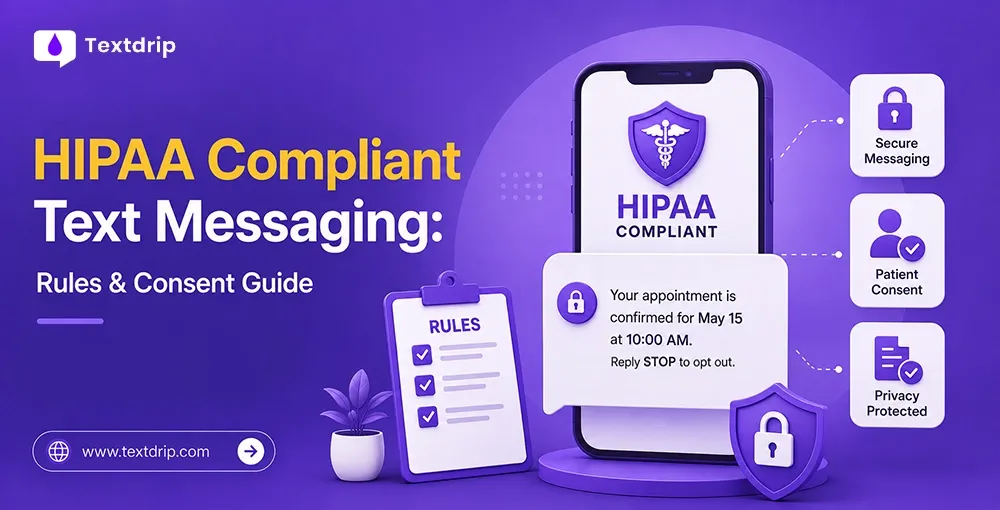
Healthcare service providers frequently communicate or share PHI (protected health information) among themselves, with other healthcare workers, or with patients. Undoubtedly, an efficient and convenient way to communicate is through text messages. While SMS offers speed and accessibility, it is not secure and remains vulnerable to data breaches. This is where HIPAA-compliant text messaging comes into the picture. However, you can’t text in the same casual way you would message a friend.
To stay compliant, you must follow specific guidelines and obtain explicit patient consent before sending any text message. In healthcare, texting without adhering to HIPAA regulations and without proper consent can expose practices to significant compliance risks.
In this blog, we will break down everything you need to know about HIPAA-compliant texting. Let’s first start with the basics.
TL;DR
- HIPAA prohibits sending protected health information (PHI) via standard SMS or apps such as WhatsApp or iMessage.
- You must use a HIPAA-compliant texting platform with access control, encryption, audit logs, and a Business Associate Agreement.
- Standard SMS does not meet HIPAA regulations and lacks adequate encryption. Texting is compliant when consent is obtained, access controls are enforced, end-to-end encryption is implemented, and complete audit trails are maintained for all PHI.
- HIPAA-compliant text messaging improves patient engagement, speeds up communication, and reduces no-shows.
- HIPAA violations can lead to fines up to $1.5 million per incident . So, send HIPAA-compliant text messages using secure platforms like Textdrip.
What is HIPAA-Compliant Text Messaging?
HIPAA-compliant text messaging is a secure way of transmitting PHI (protected health information) via text message. It means sending a text message to a patient in a way that keeps their health information safe from unauthorized access.
It’s important to understand that HIPAA-compliant text messaging to patients is not about whether you are allowed to text a patient. It is about how you do it. Protected health information includes:
- Test results
- Patients’ names paired with a diagnosis
- Prescription details
- Appointment reasons tied to a healthcare condition
Usually, text messaging in healthcare occurs between healthcare facilities and patients or among members of the healthcare team. If the message contains PHI, healthcare providers or all involved parties must maintain its confidentiality, security, and integrity at all times.
The reason for this caution is that standard text messaging doesn’t meet HIPAA standards. Regular SMS messages are stored on service providers' servers and lack the following essential features:
- End-to-end encryption for PHI
- BAA
- Audit logs
- Role-based permissions
- Remote wipe capabilities if the phone is lost
HIPAA-compliant text messaging is the solution to this because it maintains technical, administrative, and physical safeguards.
Administrative safeguards include:
- Staff training
- Written policies and procedures
- Risk assessment
Technical safeguards include:
- End-to-end encryption
- Multi-factor authentication
- Activity tracking
- Login controls
- Remote wipe or auto-delete options
Physical safeguards include:
- Encrypted, password-protected devices
- Automatic log out or time-outs on apps
- Use of MDM - Mobile Device Management
- No public Wi-Fi when transmitting PHI.
One thing to keep in mind here is that there are no HIPAA rules that restrict text messages when a patient starts the conversation . HIPAA rules apply only when a healthcare service provider sends the text message.
To stay compliant, you must use the text messaging platform that maintains all of the above safeguards.
The HIPAA-Compliant Text Messages Rules

Source: Link
HIPAA’s requirements for digital communication apply to any platform or system that transmits, stores, or has access to PHI (protected health information). Here are some key HIPAA rules and requirements for text messaging.
1. Business Associate Agreement
Any third-party service provider that handles PHI must sign a BAA with your organization. If your texting service provider refuses to sign a BAA, they are not HIPAA compliant, and this is non-negotiable.
2. End-to-end Encryption
Text messages that contain PHI must be encrypted during transmission to prevent interception by third parties, including network operators and intermediaries. Additionally, text messages that are stored on servers must be encrypted at rest. This protects PHI in the event of a data breach or unauthorized server access.
3. Role-based Access Controls
Role-based access control limits who can view PHI. Session management, authorization, and authentication must all meet HIPAA standards.
4. Audit Trails
Your system must log all access to PHI. It helps to know who accessed which data and when. These logs must be maintained for compliance audits.
5. Create PINs or Passwords
Healthcare service providers must create a PIN or passwords to contact patients or staff members. Also, don’t use personal devices for professional work. Instead, use the organization’s assets for it.
6. Minimum Necessary Standard
Only the minimum necessary PHI should be included in the text message. A reminder SMS should say, “You have an appointment tomorrow at 3 PM,” rather than including treatment details or diagnosis code.
What are the Benefits of HIPAA-Compliant Text Messaging?
When texting is done right, it can deliver a massive ROI for your healthcare practice. HIPAA-compliant text messaging offers a wide range of benefits, including:
- Efficient and faster patient communication
- Improved care coordination among providers
- Reduced no-show rates
- Lower compliance risks
- Enhanced patient trust and satisfaction
- Fewer voicemails and phone calls
What is the Difference Between SMS and HIPAA-Compliant Texting
A regular text messaging app fails HIPAA requirements in many ways. It does not have BAA, end-to-end encryption, role-based access, and audit trails. That’s why sending PHI through a standard text messaging app is a real risk. Let’s compare standard SMS versus a HIPAA-compliant platform.
| Feature | Standard SMS | HIPAA Compliant Platform |
| Encryption | Not guaranteed | Required (in transit and at rest) |
| BAA (Business Associate Agreement) | Not available | Signed and required |
| Audit Trail | None | Built-in |
| Access Control | None | Staff-level permissions |
| Safe to Send PHI | No | Yes, when configured correctly |
What Does Patient Consent Mean?
Most healthcare service providers think they can text a patient because their number is in the system, but that’s not the case. You can’t text a patient just because they gave you their number. You need their consent first (they must agree to receive text messages from you), and that consent must be properly documented.
Patient consent is non-negotiable. Patients have the right to receive communications, including those containing PHI, from their provider via text. However, providers are required to inform patients in writing about the risks involved and that information could be intercepted by a third party if sent through an unsecured channel.
If a patient understands the risk and still wishes to receive texts, they can provide their consent. But the provider has to ask first and clearly explain the risks beforehand.
Healthcare organizations should discuss these risks with patients and have them sign a consent form acknowledging their understanding.
The consent process should cover:
- A clear note that texting carries some level of risk
- What types of messages the patient will receive
- How the patient can opt out at any time.
Healthcare organizations can’t ignore the opt-out rule. Every text conversation with a patient needs an easy way to opt out. Each text message must include a line like “Reply STOP to opt out” or another standard keyword such as CANCEL, UNSUBSCRIBE, or QUIT.
Once a patient opts out, only one final confirmation message is allowed. After that, all messaging must cease completely.
In addition to HIPAA rules, you must comply with the FCC’s Telephone Consumer Protection Act and CTIA messaging guidelines. When you obtain consent properly, it protects your practice against two sets of regulations at once.
What Can You and Can’t Text a Patient?
You can text a patient about:
- Appointment reminders (including date, time, and practice name only)
- General callback requests
- Billing reminders without medical details
However, you need a HIPAA-compliant secure texting platform if you want to send:
- Lab results
- Diagnosis details
- Medication name and dosage
- Anything that describes a specific health condition
Let’s understand this through a simple example.
A Compliant Text Message Example:
Hi Eric, this is a reminder for your appointment at Sunrise Clinic on Friday at 10 AM. Reply STOP to opt out.
In this text message, there is no mention of why he is visiting or his health details. The text message includes only basic details.
Non-Compliant Text Message Example:
Hi Mia, your blood sugar results came back high; please call us to discuss your diabetes medication.
This text message contains a diagnosis, test results, treatment details, and no way to opt out. All these details are included in an unsecured text. This type of text message should be sent using a HIPAA-compliant text messaging platform, not by a regular texting app.
How to Set Up HIPAA-Compliant Secure Text Messaging
Follow the steps below to set up HIPAA-compliant secure text messaging.
- First, choose a text messaging platform like Textdrip that is ready to sign a BAA. If any platform or service provider is not ready to sign a BAA, it’s a red flag. Don’t share PHI with them.
- Once you’ve selected the platform, train your staff. Everyone sending text messages needs to know what is allowed and what is not.
- Before you send the first text message, obtain explicit consent from the patient and document it.
- Also, set a retention and deletion policy so old messages don’t sit around indefinitely.
Before you choose a text messaging platform, ask these questions.
- Does the platform sign a Business Associate Agreement?
- Is every message encrypted, in transit and at rest?
- Can I see who accessed a conversation and when?
- Does it support easy opt-in and opt-out for patients?
Also read: Secure Text Messaging in Healthcare: What it is and Why it Matters
What Happens When You Don’t Send HIPAA-Compliant Text Messages
Failing to send HIPAA-compliant text messages can expose your practice to significant financial penalties and legal troubles. Recently, in January 2026, the U.S. Department of Health and Human Services (HHS) raised HIPAA violation penalty amounts again.
- Tier 1 violations, where a practice genuinely did not know about the issue, start at $145 per violation .
- Tier 4 violations (willful neglect), if not corrected on time, can reach up to $2,134,831.
Here are the full penalty ranges for 2026.

Source: Link
Why Does Texting Work Well for Healthcare?
Patients genuinely want to communicate via texts. According to Pew Research Center , 98% of Americans own a cellphone. It makes text messaging a direct line to nearly every patient a practice has. Even the text messaging engagement numbers support this. SMS has a 98% open rate and a 45% response rate. Almost 90% of text messages are read within three minutes of receipt.
It is the main reason why healthcare keeps moving toward texting. It is not just convenient, but it gets patients to show up.
Enable Secure Text Messaging With Textdrip
HIPAA-compliant texting is crucial for healthcare organizations to maintain the highest standards of privacy and security. Whether you want to send appointment reminders, care instructions, or claim updates, HIPAA-compliant messaging not only improves patient engagement but also helps healthcare providers reduce operational costs and stay fully compliant with regulations.
If you’re still relying on email and voicemail, the truth is your patients want and expect text messages, but they must be sent securely. A HIPAA-compliant text messaging solution like Textdrip is the best way to stay secure and keep legal hassles at bay. It signs a BAA, obtains proper consent before you send that first text, keeps PHI out of standard SMS, and provides patients with a way to opt out. Book a demo to see how this platform can help your practice keep ahead of most practices.