02 Feb 2026

Nicole Esters
02 Feb 2026
Nicole Esters
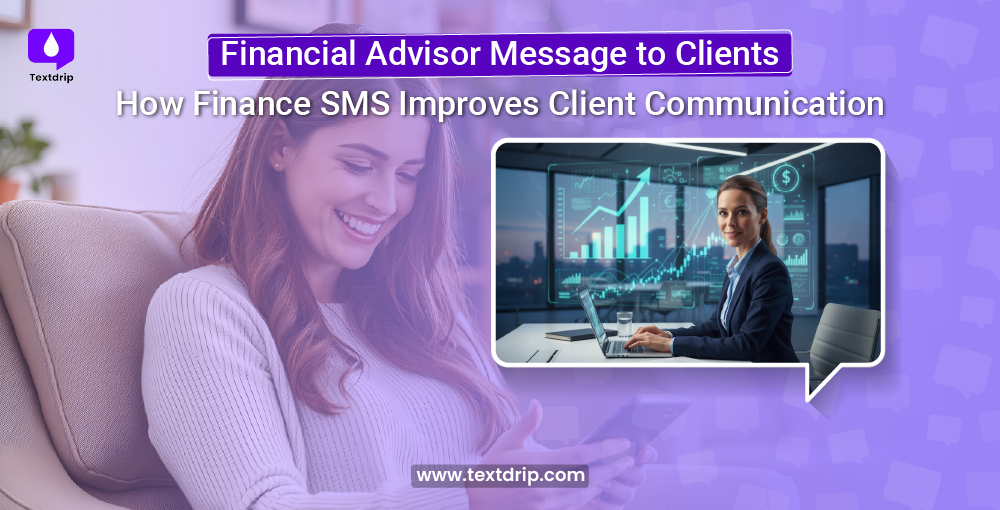
Trust plays a vital role in the financial industry. Clients don’t just hand over their money; they hand over their peace of mind. Imagine a client reads a headline about market volatility and grows anxious; they then check their inbox, but nothing. They call your office, but no one answers. This silence breeds doubt. This is where a timely message from a financial advisor makes all the difference. Communication reassures; it turns anxiety into calm and doubt into loyalty. And today, this communication is increasingly happening through financial SMS.
Financial advisors are not bad communicators, but they are busy communicators. They juggle client meetings, business growth, portfolio reviews, and compliance tasks. As a result, communication gaps arise; emails go unread, voicemails pile up, and follow-ups get delayed.
Clients don’t complain immediately, but they remember how you made them feel. When communication slows down, trust weakens.
Now, you must be wondering: if traditional channels are failing, what works better?
Let’s look at how common communication channels perform today.
| Channel | Average Open Rate | Response Speed | Client Effort |
| 20% to 30% | Hours or days | High | |
| Phone Calls | N/A | Missed or delayed | Medium |
| Finance SMS | 98% | Minutes | Low |
It’s clear that emails often sit unopened and calls interrupt busy schedules. But what about text messages? They are seen almost immediately. That’s why more financial advisors are shifting toward SMS as a primary communication channel.
Now, one question surely pops into your mind—what is financial SMS?
Let’s understand it in the next section.
Financial SMS refers to the use of text messaging to deliver timely, personalized financial information to clients. It is effective because clients are already on their phones; the messages are short and focused, and the information arrives at the right moment.
Unlike emails, SMS doesn’t compete with hundreds of unread messages. It delivers clarity without noise. However, understanding the channel is only the first step. Used correctly, it builds trust.
Trust grows when clients feel informed rather than surprised. A well-timed message from their financial advisor reduces uncertainty, demonstrates proactive care, and provides reassurance during volatile moments.
For example,
This type of concise message accomplishes three things: it acknowledges their concern, offers reassurance, and invites further conversation. In short, it builds trust through communication in just 30 seconds.
Consider these financial advisor message examples for SMS.
| Message Type | Purpose | Best Timing | Message Example |
| Appointment Reminders | Reduce no-shows | 24 to 48 hours before | Hi Mark, this is Lisa from BrightPath Financial.
Just a reminder about your portfolio review tomorrow at 3 PM. Looking forward to our discussion. Reply STOP to opt out. |
| Portfolio Review Alerts | Keeps the client informed | Before meetings | Hello Sarah, this is David at Apex Wealth. I’ve completed a review of your portfolio and shared a few notes via email. Happy to walk you through them anytime. Reply STOP to opt out. |
| Market Updates | Reassure clients | During volatility | Hi John, this is Emma from Horizon Advisors. Markets are reacting to today’s news, but your long-term plan remains on track.
Let me know if you’d like a quick review. Reply STOP to opt out. |
| Tax Season Reminders | Prevent last-minute stress | Weeks before deadlines | Hi Herry, this is Paul from Sterling Financial. This is a quick reminder to gather your tax documents ahead of our upcoming planning discussion. Reach out if you need anything. Reply STOP to opt out. |
| Meeting Follow-Up | Maintain transparency | As required | Hi Alex, this is Natalie from Clearview Wealth.
Thanks for meeting today. I’ve sent a summary of the next steps to your email. Let me know if any questions come up. Reply STOP to opt out. |
| Annual/Quarterly Check-In | Maintain routine communication | Once every 3 months or as required | Hi Tom, this is Michelle at OakTree Advisors.
It’s time for your quarterly financial check-in. Let me know what works best for you. Reply STOP to opt out. |
| Action Reminder | Polite follow-up | After meeting | Hello Robert, this is Kevin from Summit Financial.
Just checking in to see if you had a chance to review the documents we discussed. Happy to help if needed. Reply STOP to opt out. |
The best thing is that each message serves a clear purpose and respects the client’s privacy and time.
SMS doesn’t just get opened, it gets action. Statistics show that SMS open rates are around 98%, with response rates near 45%; these figures are approximately 5–8 times higher than email.
Let’s understand this through a simple example.
If an advisor sends 500 email reminders, only about 150 are opened, and roughly 30 receive responses.
If the same advisor sends that reminder via SMS to 500 clients, around 450 messages are opened, generating over 200 responses.
This difference translates into fewer missed meetings, faster communication, and happier clients. However, engagement remains high only when communication is consistent.
Manual texting works perfectly until your business scales. As your client base grows, manual follow-ups become time-consuming, error-prone, and inconsistent. SMS automation solves this.
Using automated financial SMS, advisors can send reminders automatically, trigger messages based on client events, and ensure no client is overlooked.
Here is an example of what an automated flow looks like:
A client books a review.

SMS confirmation sent instantly
Reminder sent 24 hours before
Follow-up message sent after the meeting
It means no extra effort and missed steps.
SMS automation doesn’t mean sending robotic messages. Modern platforms like Textdrip allow for personalization using the client’s name, the advisor’s name, meeting dates, and account milestones.
For example,
Personalization makes clients feel seen, which fosters loyalty and retention. Crucially, this practice must always respect SMS compliance rules.
Compliance is not optional in finance, but it shouldn’t be complicated. Your financial SMS must include explicit opt-in consent, clear opt-out instructions in every message, and secure record-keeping.
Automated SMS marketing platforms like Textdrip simplify this by automatically adding opt-out language, storing message history, and reducing manual errors.
This means when you use such a platform, SMS compliance becomes part of your process, not a roadblock.
It’s a fundamental principle that you can’t improve what you don’t measure. Here are the most crucial SMS metrics for financial advisors:
| Metric | What it Shows | Business Impact |
| Delivery rate | Message reach | Data accuracy |
| Response rate | Client engagement | Relationship strength |
| No-show rate | Appointment success | Time saved |
| Opt-out rate | Message relevance | List quality |
Tracking all these metrics helps financial advisors fine-tune their messaging strategy over time.
Let’s dispel some common myths about the financial SMS industry.
The first myth is that SMS is too casual for finance. In reality, clients value clarity over formality.
A second myth is that clients will feel spammed by SMS messages. The truth is that clients welcome relevant, timely messages and rarely ignore them.
A third myth is that SMS compliance is risky. However, with the right tools, SMS compliance can be easier to manage than email compliance.
Once these myths are addressed, SMS becomes an obvious choice.
Today’s clients expect faster updates, fewer emails, and more transparency: financial SMS meets all these needs.
For advisors, adopting SMS now leads to stronger client relationships, higher retention, and a distinct competitive advantage.
Ultimately, the future of financial communication is mobile-first and automated.
The conclusion is clear: Financial SMS is not just convenient but essential. Textdrip helps financial advisors automate and personalize client communication at scale while ensuring compliance through built-in controls like opt-out management. This allows you to improve response rates without additional effort.
Instead of chasing follow-ups, you can focus on what matters most: advising.
For smarter communication, stronger trust, and better client engagement, Textdrip is the ideal tool. Book a demo today to experience how Financial SMS can become your growth engine.
Yes, financial SMS can be fully compliant when executed correctly. Advisors must obtain client consent, include clear opt-out instructions, and maintain detailed message records. Using an automated platform like Textdrip simplifies adherence to these rules, making SMS compliance a seamless part of the process rather than a burden.
Yes. Financial SMS is cost-effective and easy to manage, even for small teams. It allows local advisors to maintain client connections without needing extra staff. Through automation, it ensures consistent communication without adding to your workload.
Financial SMS keeps clients informed, reassured, and updated in real time. Regular, timely messages reduce uncertainty and demonstrate proactive care. When clients feel consistently informed, trust grows naturally over time.
The most effective updates include appointment reminders, market insights, portfolio review alerts, and tax deadline notices. These messages are timely, helpful, and expected by clients. They add clear value without feeling promotional or intrusive.

As Textdrip’s CFO, Nicole oversees the company’s financial operations and resource allocation. She’s a strategic partner at Textdrip to drive… Read More
02 Jun 2026
Nicole Esters
26 May 2026

TJ Gaushas

28 Jul 2025
TJ Gaushas

04 Oct 2024
TJ Gaushas
As Textdrip’s CFO, Nicole oversees the company’s financial operations and resource allocation. She’s a strategic partner at Textdrip to drive… Read More