Have you ever experienced this? A customer books an appointment but never receives a reminder, so they forget to show up, and you lose money. Now, consider a different scenario: a customer books an appointment and receives an automatic text reminder at the perfect time. As a result, they show up, and you secure your revenue. This is the power of an SMS API.
Today, businesses often fail not because of bad products, but because of missed messages, slow replies, and poor communication. Modern customers expect instant updates, clear information, and timely alerts. This is precisely where API-driven SMS messaging becomes an integral part of a modern business system.
In this blog, we will discuss why integrating an SMS API is beneficial, how these systems work, and how they can help businesses grow more reliably and efficiently in 2026.
But before we dive into the features and benefits, let’s first understand what has changed.
What Has Changed In 2026 In Terms Of Business Communication?
Customers today won’t wait. They won’t refresh their email or open an app, but they will read a text message instantly.
In 2026, businesses operate in a world of shorter attention spans, higher competition, and a level of trust that depends on how quickly you respond to customers.
This means a single delayed message can result in a lost sale, a failed login, or a frustrated customer. That’s why companies across industries are shifting to SMS API integration to automate their most important communications.
Now that you understand how business communication has evolved, let’s explore what a text message API is.
What is a Text Message API?
Let’s explain a text message API in the simplest terms. A text message API is a tool that enables your software, such as a website, app, or CRM, to send and receive text messages automatically via an external SMS platform.
Think of it this way: instead of someone typing and sending messages one by one, your system can dispatch them automatically based on specific triggers. This eliminates the need to send SMS from a provider’s dashboard; you can use the API to fully automate the process.
For example:
- When someone signs up, your system can send them an OTP via SMS.
- When an order ships, it can trigger a delivery update.
- When an appointment is scheduled for tomorrow, it can send a reminder.
- The best part is that all of this happens without any manual effort.
How a Text Message API Works?
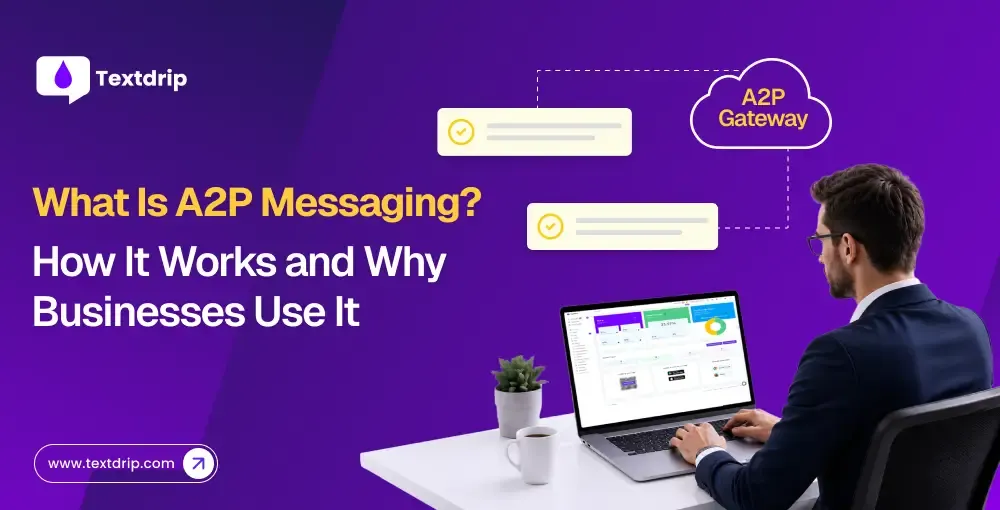
A text message API acts as a middleman between your selected software and an SMS provider like Textdrip . Let’s understand how it works.
1. A trigger is defined.
You can choose a trigger for your business, like a customer placing an order, submitting a form, or confirming an appointment.
2. Your software calls the API
When a specific trigger occurs, your software sends a request to the API. That request includes the message content, the phone number, or any additional information.
3. The SMS provider sends an SMS.
The SMS software receives the request and sends an SMS almost instantly.
4. You receive feedback in real-time.
Once you send the message, the API notifies your system whether it was delivered. Therefore, you can monitor performance and troubleshoot if required.
For example,
If your app or website needs to send a text, like a shipping update or a login code, it instructs the SMS API to “send this SMS to this phone number.” The SMS API takes your request and converts it into a format that mobile networks can understand. It then forwards the message to the recipient’s mobile network, which finally delivers it to their phone.
If the person replies, the API sends that reply back to your software. It also handles all other technical steps, such as retrying failed messages and checking for errors. This allows you to send thousands of messages without manual intervention.
Now, how does this API-driven SMS messaging differ from regular SMS? Let’s explore that in the next section.
Regular SMS Vs API SMS Messaging: Quick Comparison
Many businesses start with SMS from personal phones, but they quickly find it impossible to manage as they grow. To understand why, let’s look at a side-by-side comparison.
| Feature | Regular SMS | API SMS Messaging |
| Sending Messages | Manual | Automatic |
| Speed | Slow | Instant |
| Message Volume | Limited | Scales Easily |
| Personalization | No | Yes |
| Two-way Replies | No | Yes |
| Analytics and Tracking | None | Real-time Data |
In summary, while regular SMS works for personal communication, an SMS API delivers the speed, scale, and control that modern businesses require.
Why SMS Messaging API Beats Email, WhatsApp, and Push Notifications?
Businesses often ask, “Why not use email or WhatsApp?” The short answer is that SMS is far more reliable.
| Channel | Open Rate | Internet Needed | Works on All Phones |
| Low | Yes | Yes | |
| Medium | Yes | No | |
| Push Notifications | Medium | App Required | No |
| SMS Messaging API | Very High | No | Yes |
As the table shows, text messages don’t require an app, an internet connection, or hours to be opened. This inherent reliability is why SMS API messaging serves as the most trusted communication channel for urgent updates.
What’s the Real Cost of Not Using an SMS Messaging API?
For a business owner, not using an SMS API has a real cost. Every missed message creates friction, which erodes trust and ultimately leads to lost customers.
| Problem | Business Impact |
| Missed appointments | Lost revenue |
| OTP failures | Lower sign-ups |
| Late delivery alerts | Customer complaints |
| Manual follow-ups | Team burnout |
Integrating an SMS API into your systems eliminates these risks by ensuring the right message reaches the right person at the right time.
What are the Benefits of Using a Text Message API?
To enhance your business communication, a text message API offers significant benefits. Let’s explore a few of the key advantages.
1. Grab Immediate Attention
The SMS API ensures your messages reach customers instantly, making it one of the most effective communication channels available. Most people open a text message within three minutes, and studies show that Americans check their phones an average of 144 times per day . This means your reminders, alerts, and promotions are seen almost immediately, leading to significantly higher engagement, response rates, and customer interaction.
Unlike emails or push notifications that often go unnoticed, SMS creates a direct, personal connection with recipients, prompting them to take quicker action.
2. SMS Automation
An SMS API enables businesses to send automated text messages , like appointment reminders, order updates, and payment alerts. The most significant benefit, however, isn’t just time saved; it’s increased customer satisfaction. According to a study, 43% of customers cite better customer service as the top advantage of SMS automation.
For example, an e-commerce business can automatically send texts such as “Your package is on the way” or “Your order is ready for pickup!” after a purchase. Sending these timely updates keeps customers informed seamlessly, without requiring any manual effort from the team.
3. Two-Way Conversations
An SMS API allows customers to reply directly, transforming simple text messages into genuine conversations. This increased engagement ultimately leads to a better return on investment (ROI) for your business.
4. Cost-Effective
Traditional marketing is often costly and inefficient at reaching the right audience. An SMS API solves this by enabling you to send quick, affordable, and personalized messages directly to thousands of opted-in customers. This direct line not only ensures your updates are seen by the right people but also helps drive business growth.
5. Required No Maintenance
A cloud-based SMS API eliminates infrastructure headaches by having the provider manage updates, security, and scaling. Your team simply integrates the API and focuses on sending messages.
This means no more worrying about server crashes or compatibility issues. The API functions like a dedicated 24/7 IT team, seamlessly managing your entire messaging backbone.
6. Improved Efficiency
Automating your messages improves team workflow, saves time, and reduces human error. It frees your sales representatives and staff from repetitive manual tasks. You’ll never forget to send a critical message, and by integrating tools like Landline Remover , you can ensure messages are never sent to the wrong number. With a system-driven approach, overall efficiency is significantly improved.
7. Improved Security, Compliance, and Trust
A reliable text message API supports critical functions like OTP-based logins, payment confirmations, account alerts, and fraud warnings. Because these messages are automated and fully logged, businesses can effortlessly maintain compliance, track delivery, and build user trust.
How Text Message API Improves Customer Engagement?
Customer engagement isn’t just about sending more messages; it’s about sending better ones. A text message API enables this by facilitating personalized, action-based messaging and genuine two-way conversations.
For example,
- Hi Herry, your order will arrive today.
- Reply YES to confirm your appointment.
- Need help? Reply HELP anytime.
These messages feel personal, not promotional. That’s why customers respond.
Business Workflow: Before Vs After API SMS Messaging Implementation
Let’s understand how daily work changes once you integrate SMS APIs.
| Team | Before | After |
| Sales | Manual follow-ups | Automated lead nudges |
| Support | Calls and emails | Instant SMS replies |
| Operations | Phone updates | Real-time alerts |
| Marketing | Guess-based campaigns | Trigger-based SMS |
The result will be less stress, faster action, and happier teams.
Use Cases of SMS Messaging API
Almost every industry uses an SMS API, but their implementations differ. Here are a few examples where the SMS messaging API delivers real impact.
| Industry | Use Case |
| Ecommerce | Order confirmations, delivery updates, payment alerts, etc. |
| Healthcare | Appointment reminders, test result alerts, follow-up messages, etc. |
| Banking and Finance | OTP verification, fraud alerts, transaction updates, etc. |
| Education | Exam notifications, fee reminder, class update, etc. |
| Travel and Hospitality | Booking confirmation, check-in alerts, schedule changes, etc. |
| SaaS and Startups | Login OTPs, trial expiry alerts, system notifications, etc. |
How to Choose the Right SMS Messaging API For Your Business?
Before you choose an SMS messaging API, you should ask the following questions.
- Is integration easy?
- Are messages delivered fast?
- Does it support two-way SMS and drip campaigns?
- Can I track performance?
- Is support reliable?
Remember, the right API SMS messaging partner should simplify your work, not add complexity. If answer of these questions are YES, it’s a green signal.
What is the Future of Text Message API in 2026 and Beyond?
Gone are the days when SMS was “just texting.” In 2026 and beyond, we can expect AI-triggered messages, behavior-based alerts, integrated SMS and chatbot workflows, and smarter personalization.
With this evolution, text messaging APIs are transforming from simple delivery tools into intelligent communication engines.
Turn Your SMS into a Business-Ready Communication Channel With Textdrip
As the discussion above demonstrates, a text message API is not optional in 2026—it is essential. To accelerate business communication, deliver reliable alerts, improve customer engagement, and scale effectively, SMS API messaging is vital. This is precisely where a solution like Textdrip can help.
Textdrip helps businesses:
- Automate SMS communication easily
- Send secure, high-speed messages at scale
- Enable two-way customer conversations
- Track performance with precise analytics
Whether you’re a growing startup or an established enterprise, Textdrip provides the tools to transform SMS into a powerful communication channel. To ensure your business never misses a critical message in 2026, book a Textdrip demo today and experience the difference.